Reciprocity
Failure
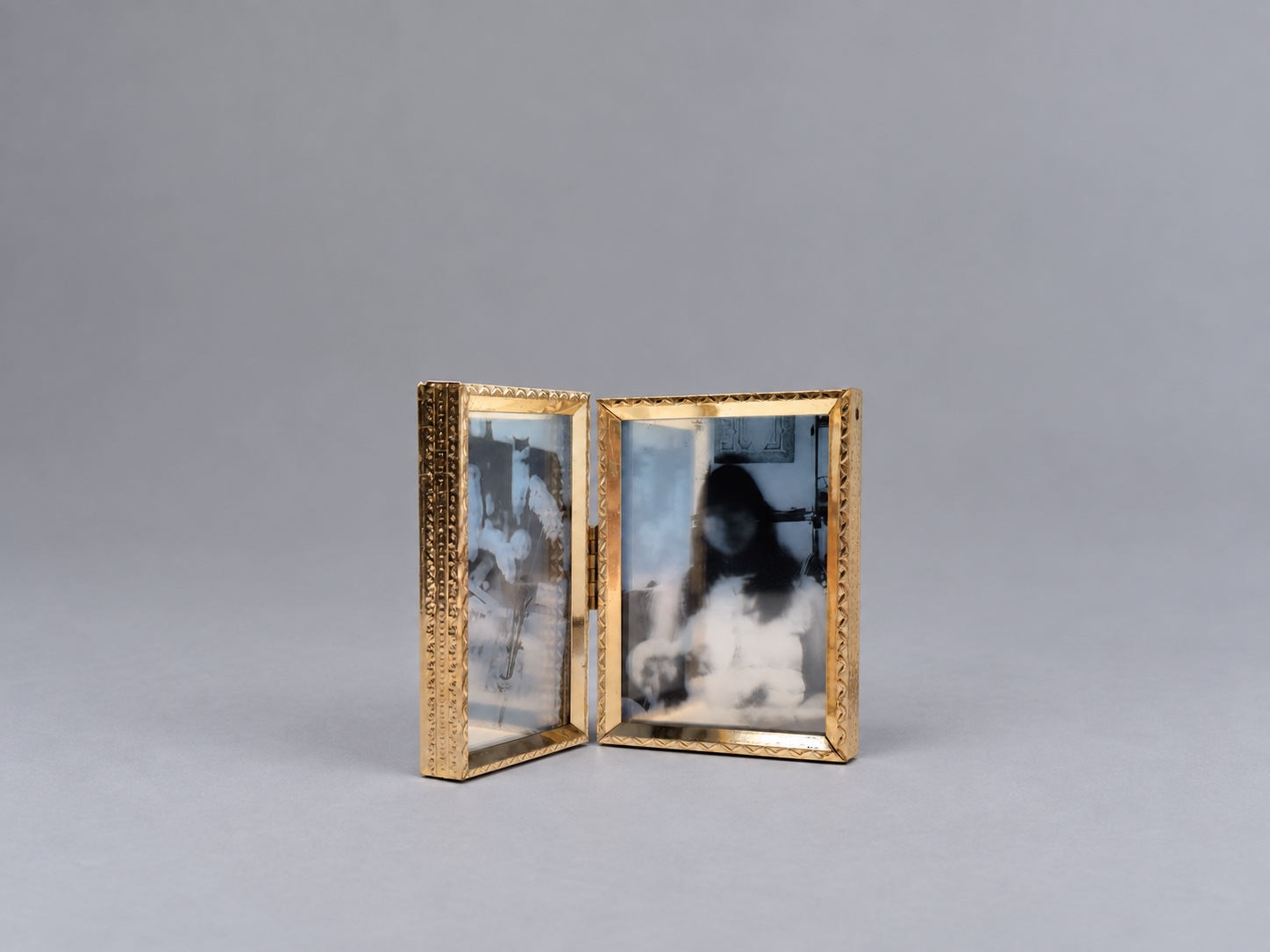
Large-format photographs on transparency film, mirror, antique-style folding frames, directional speakers, two Mandarin audio recordings, wall text
Dimensions variable
In photography, reciprocity failure occurs when film stops responding proportionally to light during an extended exposure. More time no longer produces a corresponding amount of image.
For this work, I interviewed two friends who came to the United States under different circumstances. Each conversation became the duration of a large-format exposure: the shutter remained open while they spoke. Their bodies moved with the telling, and the longer the exposure continued, the less clearly they appeared.
Each portrait is paired with a photograph of an object of personal remembrance: an eyeshadow palette, chrysanthemums. The objects stayed still and were recorded clearly.
After her grandmother died, one participant set chrysanthemums on Lake Michigan. The waves returned them to the shore. The flowers could not float back to China, she said; they would always be carried onto some other land.
Each pair of images is presented in a small antique-style folding frame resting on a plinth at hand height, which viewers can open themselves. The images are printed on transparency film and laid over a mirror, so they hold a faint silver sheen rather than the flatness of paper. At certain angles the viewer’s own face appears within the picture, though some may not notice it at all.
The interviews remain in Mandarin. Above each frame, a directional speaker plays the recording on a loop, audible only to the person standing before it. On the wall beside it, a single English sentence summarizes the speaker’s circumstances in the register of an institutional account. It is not a translation. It reveals enough for the story to become recognizable, while removing the hesitations, contradictions, and emotion through which it was told.
Each story arrives in three forms: an image, a voice, and a sentence. The image registers the time of telling but not its words. The voice carries the words, and the breath between them, to anyone who stands close enough and understands Mandarin. The sentence can be read by almost everyone, and it holds the least. None of the three can stand in for the others, and no two viewers receive them in quite the same way.